

By Monika
Hiking in Iceland – Essential Tips for the Best Experience.
Hiking is one of many ways to experience the wonders of nature in Iceland. It certainly is my favorite Iceland activity! Iceland is known for beautiful hiking trails – some even call it a “hikers’ paradise”!
Going on a hike allows you to explore all those magical areas that are not accessible by car and experience the raw and rugged beauty of the more secluded places, oftentimes away from the crowds.
To help you prepare for both short and long nature treks, I’ve compiled this easy-to-follow list of practical hiking tips.
Learn everything you need to know to prepare for an amazing and safe experience of hiking in Iceland.
This post contains affiliate links to trusted products and services that I use and love myself. If you make a purchase through these links, I may receive compensation at NO EXTRA COST TO YOU. I appreciate your support! Also, as an Amazon Associate I earn from qualifying purchases. See the Disclaimer Policy and the Privacy Policy for more details.
Best time for hiking in Iceland
I recommend planning your hikes for the summer months and early fall. You can never predict Icelandic weather but from May till the end of September you have the best chance for good weather and the most daylight, so you can plan more or longer adventures.
Hiking trails located in the highlands are only accessible in the summer, usually from late June to early September, but the opening dates are very weather-dependent and vary from year to year. Check road.is for road status.
Some easy hikes are accessible in the winter months, but I’d only recommend attempting them if you are an experienced winter hiker and have the proper clothing and gear.
Check the weather conditions before you head out
Please check it on the Icelandic Meteorological Office’s official website, not on your phone weather app! Iceland’s weather changes quickly and only that site or the app will give you the most current and accurate forecast.
Also, check any travel alerts both for driving and hiking/outdoor activities. Be especially mindful of strong wind forecasts – weather alerts in Iceland are not issued lightly and there is always a good reason they are set.

Consider the length of the hike and the amount of daylight
Schedule your hike for the appropriate time of the day, so that you have more than enough time to get to your destination, enjoy the view and hike back.
Unless you take a guided night hiking tour you should always finish your hikes in daylight.
To have the most flexibility in your schedule you can consider planning your trip in the Midnight Sun months – May/June/July.
Consider the difficulty level of the hike
It may sound common sense, but I do want to put it out there. Challenging yourself a bit is motivating and rewarding, but challenging yourself way past your abilities may result in accidents and injuries and possibly ruin the rest of your trip.
Choose your hikes according to your fitness level and endurance, and consider any mobility issues, fear of heights, etc. to stay safe and enjoy yourself.

Are you comfortable on a narrow, rocky trail? Crossing streams? Near steep drop-offs? Or do you prefer wider and milder paths?
Research your route well and make sure you know what to expect.
Research how you will get to the trailhead
Know where your trail begins and how to there. Is it on the Ring Road or in the remote Icelandic Highlands? Do you need a 4×4 vehicle? Do you need to cross any rivers? How long is the drive to the parking lot for the hike?
You need answers to all these questions to plan your hiking adventure well.
If you do plan on hiking in the Highlands, read this guide: How to Visit the Highlands of Iceland – 15 Essential Tips for a Safe Road Trip.


LEARN MORE: Renting a Car in Iceland – How to Choose the Right Car for Your Trip.

Have proper hiking gear
I can’t stress this enough – please be prepared with proper hiking equipment, especially for longer, more difficult trails.
By proper, I certainly don’t mean fancy or expensive. Just don’t try to hike in Landmannalaugar in canvas shoes – yes, I’ve seen that when we hiked there!
Hiking footwear
Wear sturdy, ankle-high WATERPROOF hiking boots with good traction, or at the very least, trail runners for easier, shorter hikes. I have both and switch between them depending on the trail we’re on.
The terrain varies from dirt to gravel to rocky and can get slippery after the rain.
Hiking poles
They are not needed for every hike but are in my opinion, are a necessity for some, like the Bláhnúkur-Bennisteinsalda loop in Landmannalaugar or the Múlagljúfur Canyon trail.
They provide extra support and that extra point to lean on in more challenging sections.

Day pack
You need a day backpack to carry your trail necessities with you!
I’ll explain what those necessities are in sections below, but again – please don’t go on a 4-5 hour hike with just a bottle of water in your hand! Yes, I did witness that too…
You are much better off never using what you carry in the backpack (although a very unlikely scenario) than needing something that you don’t have in the middle of a long hike.

Wear layers
I’m sure you’ve heard it before but I’m going to say it again – always dress in layers! It may be cold in the morning and get really warm and sunny later, possibly windy at the summit and rainy on your way back. You just never know and should be able to easily adjust your clothing.
If you need help packing for Iceland, check out this practical list of Iceland essentials, that I always follow for my Iceland trips!
Pack for all seasons
That’s what you need your day backpack for! Even if you head out on the trail on a warm and sunny morning you should have rain gear, a packable warm jacket, a hat and gloves in your pack. You just never know what you’re going to need.
Carry snacks and water
That also goes in your pack.
Make sure you have enough snacks and water for the duration of the hike. Pack lunch if needed. Pack a little more than you usually eat – you’ll be burning more calories hiking, so you may snack more than usual.
Check if your route has a stream where you can refill your water bottle! If not, pack enough to stay hydrated.

Have a first aid kit
Minor injuries can happen no matter how careful and prepared you are. Have a small first aid kit in your backpack with band-aids, antiseptic wipes, a bandage etc., to take care of them on the trail.
Know your hiking trail
As I said earlier, research your route! Depending on how remote the location of your hike is, consider getting a paper map of the area to help you navigate.
Download an app with the offline map of the trail on your phone, if possible. This is critical for longer, more adventurous hiking trails, like the Laugavegur or Fimmvörðuháls, and other trails in the Highlands where reception may be spotty at best.
Stay connected
Cell phone reception is usually good in Iceland but if you have a portable Wi-fi hotspot (I always add one to my car rental), make sure it’s charged and take it with you. You’ll be able to use a navigation app and call for help in case of an emergency.
You can also stay connected during your trip with an eSIM like Airalo, Saily or Sim Local!

Use promo code PLANPACK to unlock your 5% discount!
Know Iceland’s emergency contacts
Iceland’s emergency phone # is 112
Download safetravel.is app on your phone – under “hiking” you have the option to check in with your location as you travel and also send an emergency signal with your location if you need help.

Let someone know where you’re planning to hike
That is especially important if you hike solo, but you can do it for any trip/hike.
Also, it’s very important for longer treks.
On the safetravel.is website there is an option to submit your travel plan – that way, in case of an emergency, the rescue team will know where to go to help you.
READ MORE: Best Apps for Iceland – What I Use, Love and Recommend!
Use common sense to avoid emergencies
Please be careful, smart and reasonable on your hikes!
Know when to turn back vs pushing forward, especially if you don’t have proper clothing and equipment to continue. Whether it’s due to the weather, lack of food/water, injury or exhaustion – assess the situation and decide what’s best.
Pay attention to your surroundings, too – there are usually no barriers at the canyons and cliffs reminding you to keep a safe distance from the edge.

Stay on the trail
Protect Icelandic nature and stay on the trail! Do not step on the fragile moss and other vegetation – it takes years to grow back. In active geothermal areas stepping off the trail can be dangerous.
Respect any warning signs!
Leave no trace
Bring a bag for all your trash and collect it till you get back to “civilization” – do not litter! After all, we hike to enjoy the unspoiled environment, let do our part to keep it that way.
Hiking in Iceland can be a truly unforgettable experience – whether you choose a short easy hike, a more adventurous day hike or a multi-day trek, you’re in for an amazing adventure and stunning views.
Know when to book a hiking tour with a local guide
If you’re not up for taking on the more challenging hikes on your own, especially those located in the Highlands, you can book a guided hiking tour to ensure your safety and comfort. That’s especially important to consider for multi-day hikes, like the famous Laugavegur Trail.
Many tours offer both the “meet on location” option and a pick-up in Reykjavik.
Consider these guided hiking tours:
As I said earlier, I believe that hiking is one of the best things to do in Iceland and there are many fantastic hiking trails to choose from.
You can stay on well-trodden popular routes or go off the beaten path for a more remote adventure. Whichever option you choose, do it with safety in mind.
READ MORE: 10+ Easy Hikes in Iceland You Shouldn’t Miss!
READ MORE: Best Day Hikes in Iceland: 10 Stunning Trails for Your Itinerary.
Follow tips in this article to prepare for the best possible hiking experience in Iceland!
Quick reference checklist for hiking in Iceland
📌 Best Time to Hike
✅ May–September for best weather & daylight
✅ Highland trails: open late June–early September (check road.is)
✅ Winter hikes: only for experienced hikers with proper gear
📌 Before You Go
✅ Check the weather: Only use Icelandic Meteorological Office for an accurate forecast.
✅ Check travel alerts: check road status & safety updates.
✅ Know your trail & difficulty level
✅ Plan your route & transport (some trails require a 4×4 vehicle)
📌 Hiking Gear Essentials (use my packing list for guidance!)
✅ Footwear: Waterproof hiking boots (ankle-high) or trail runners for easy hikes
✅ Clothing: Dress in layers + pack rain gear, hat, gloves
✅ Day Pack: Carry water, snacks, map, first aid kit, extra clothing
✅ Hiking Poles: Useful for steep or uneven terrain
📌 Safety First
✅ Tell someone your hiking plan (or submit your travel plan on safetravel.is)
✅ Stay on marked trails – protect nature & avoid dangerous areas
✅ Know emergency contacts: Call 112 in case of an emergency
✅ Download offline maps (some remote trails have no reception)
✅ Use common sense! If the weather turns bad, turn back.
📌 Respect Nature
✅ Leave no trace – take all trash with you
✅ Follow warning signs – geothermal areas & cliffs can be dangerous
FAQ:
Yes! Just follow the safety tips outlined above and you will have a great time on the trails!
Solo hiking is possible, but extra precautions are needed:
✔ Inform someone of your plans or register your hike on SafeTravel.is
✔ Carry a paper map & download an offline navigation app
✔ Check weather & road conditions before heading out
✔ Avoid remote hikes in bad weather
If you’re new to hiking, try:
✔ Kvernufoss Waterfall Hike (easy, about 20 minutes each way)
✔ Seljavallalaug Geothermal Pool Hike (short walk, about 20 minutes each way)
✔ Reykjadalur Hot River Hike (easy/moderate, about 1 hour each way)
Check my best easy hikes and best day hikes guides for more guidance.
Layers on your body and a good pair of hiking boots on your feet! Bring a waterproof and windproof jacket, hat and gloves even if you don’t think you’ll need them!
Yes, but only if you have winter hiking experience, only on certain trails and with proper winter gear.
Yes, you can! But only with an experience glacier guide for your safety.
Read my guide to the best glacier hikes in Iceland for more information and a glimpse of what glacier hiking is like!
Yes! Iceland’s water is among the cleanest in the world. You can also carry a water bottle with a filter just to be safe.
✔ Stay put & stay calm – moving further can make rescue harder
✔ Use the SafeTravel app to send an emergency signal
✔ Call 112 if there’s an urgent safety risk
👉 Don’t forget TRAVEL INSURANCE! I don’t travel without it. Get a quote from my personal #1 choice – Travel Guard – or check more options here!

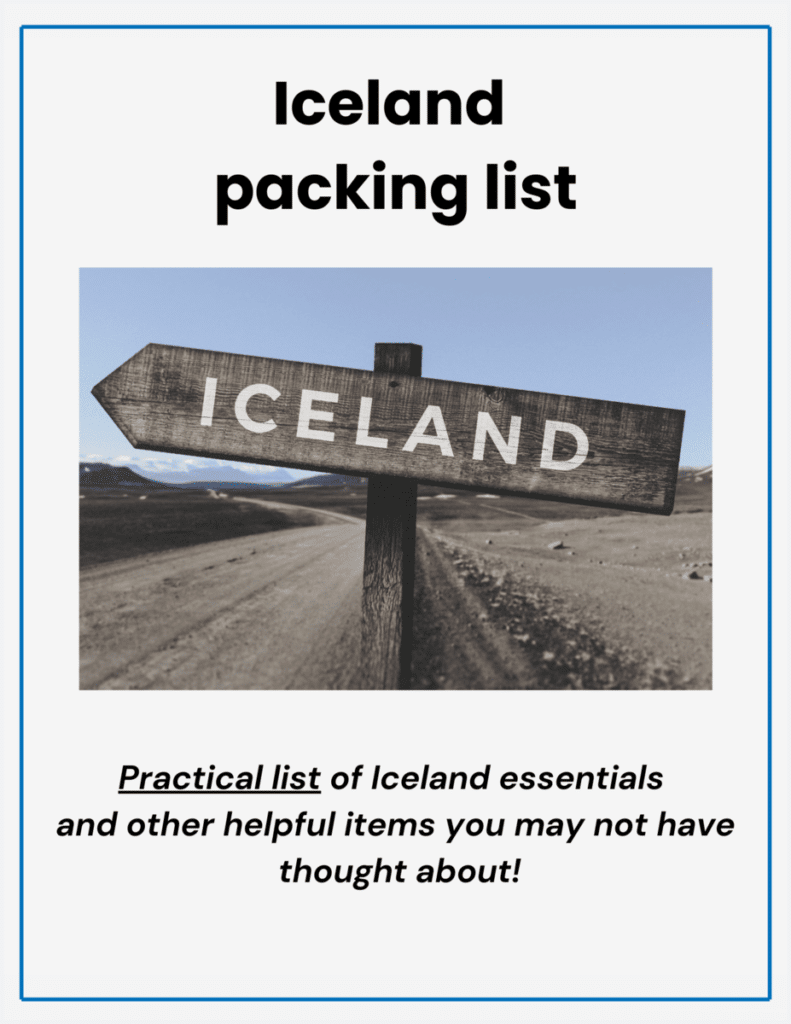
Let me help you pack for your trip!
Get organized with this printable, fillable, practical ICELAND PACKING LIST!
Imagine all your Iceland essentials organized in a checklist that you can access from any device or print to have a hard copy!
Make packing for Iceland easy with this comprehensive, easy-to-follow checklist!
You may also like:
- 6-day Iceland Itinerary (How to See the Best of Iceland in a Short Time)
- Golden Circle in One Day – Full Guide to the Main Stops and Best Detours.
- Snæfellsnes Peninsula – A Complete Guide and Top Things to See.
- 15 Best Things to Do in Iceland.
- Dyrhólaey, Iceland – the Iconic Arch with a Hole and More!
- Friðheimar Tomato Farm – a Unique Dining Experience in Iceland.
- The Amazing Kerlingarfjöll and Hveradalir Geothermal Area in Iceland.
- Diamond Circle in North Iceland – a Perfect Itinerary.
- Seljalandsfoss and Gljúfrabúi – How to Visit Two Stunning Waterfalls.
For more Iceland inspiration and travel guides click HERE.
Need more help planning your trip? Join my Explore Iceland: Travel Tips & Advice FB Group community to ask questions, share your experiences, plus get expert travel tips and advice from a supportive community of Iceland enthusiasts! Join today!
🎙️ Prefer to listen to the travel guides instead? Check out my Explore Iceland Travel Podcast and easily plan your trip on the go!
About Monika
An avid traveler and a passionate trip planner, mildly obsessed with being organized and prepared 🙂
Well aware of how precious travel time is, I’m here to share my experience and help you get the most out of your vacation time.
“Taking the hassle out of trip planning”
